
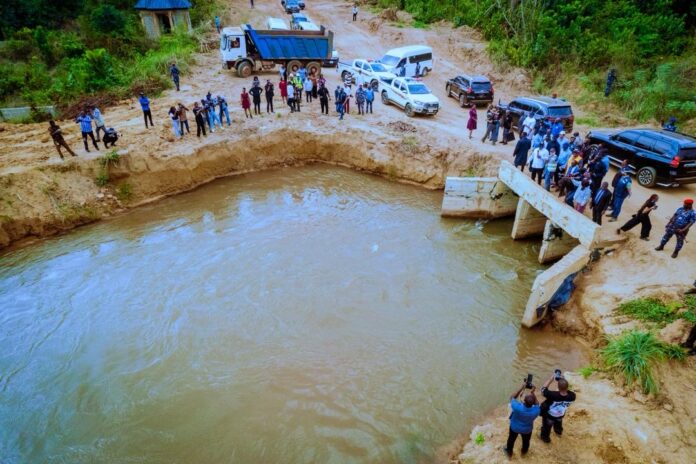

Governor of Delta State, Rt. Hon. Sheriff Oborevwori, has reaffirmed his administration’s commitment to quality infrastructure and timely project delivery during inspection visits to the ongoing Ugbolu–Okpanam and Phase 2 of Oko-Anala – Oko-Ogbele – Oko-Odifili Road projects.
Speaking during the inspection of the 12.12-kilometre Ugbolu–Okpanam Road on Tuesday, the Governor said his visit was aimed at personally assessing the progress of work rather than relying solely on reports from engineers.
“I did not just come here casually, I came to personally inspect and see for myself the level of work,” he said, emphasizing that follow-up is as important as groundbreaking and commissioning ceremonies.
Governor Oborevwori recalled that he began giving serious consideration to the project around July last year due to the persistent movement challenges experienced by residents along the corridor. The groundbreaking ceremony was performed in October.
The Governor disclosed that although the original timeline for the project is 18 months, the contractor has assured the state government of completion by December this year.
The road, he explained, is designed with 7.7-metre-wide concrete drains on both sides, with an overall width of approximately 11 metres and an 8-metre main carriageway.
According to him, the extensive drainage system is critical given the flooding challenges in the area, adding that Okpanam sits on higher ground, causing water to flow into surrounding lower areas, which has over the years led to severe flooding.
The ongoing construction of comprehensive drainage channels, he said, would redirect water safely to the river and significantly address flooding concerns.
He said: “Some of the previous drain systems were either single or double but not adequate to handle the volume of water. We are ensuring that this drainage infrastructure is comprehensive and durable. Residents will notice the difference during the rainy season”.
Describing the road as strategically important, Oborevwori said it connects Ugbolu and Okpanam communities, enhances social and economic activities, and promotes unity between urban and semi-urban areas.
He stressed that his administration is deliberate about inclusive development, noting that infrastructure projects are being spread across various local government areas to ensure balanced growth.
“We are not only constructing flyovers and roads in urban centres; we are also extending infrastructure to rural communities. Development must be balanced,” he said.
At the Phase 2 of Oko-Anala – Oko-Ogbele – Oko-Odifili Road project site, Governor Oborevwori reiterated his insistence on meaningful progress and strict adherence to timelines.
He explained that the project was structured in phases, with Phase One covering approximately 4.7 kilometres now completed. Phase Two, which spans about five kilometres, remains outstanding.
The Governor described the terrain as extremely challenging, revealing that large quantities of unsuitable clay soil had to be excavated and removed to ensure a stable foundation.
He said: “If you do not properly remove unsuitable soil and stabilise the base before filling, the road will not last,” disclosing that the contractor had initially projected completion of Phase Two by August 2027, a timeline he firmly rejected.
Oborevwori assured residents of Oko-Anala – Oko-Ogbele – Oko-Odifili Road projects, that the state government has fully mobilised the contractor and made funds available, stressing that there are no financial constraints from the government’s side.
He urged the contractor to intensify effort and complete the project before the end of this year or early next year, saying; “if contractors want more jobs from this administration, they must deliver quality work and complete projects on time”.
Reaffirming his administration’s guiding principle, Oborevwori declared: “We believe in standards, and we will not compromise on quality.”
